
Last updated June 28, 2026
Garage Door Maintenance Checklist for Los Angeles Homeowners
The number-one maintenance mistake we see from Los Angeles homeowners isn’t skipping lubrication — it’s using the wrong lubricant in summer heat. A $6 can of WD-40 becomes a spring-gumming disaster within 90 days in Southern California temperatures. After 11 years and more than 1,200 service calls across Los Angeles, Christopher Moore has watched perfectly repairable doors turn into full replacements because the owner was following a maintenance schedule written for Minneapolis winters, not a Reseda summer. This guide resets those assumptions. You’ll learn what to do, when to do it, and how LA’s specific climate — marine layer, Santa Ana winds, 100°F heat spikes — changes every rule you thought you knew.
Quick Answer
A complete garage door maintenance routine for a Los Angeles home takes about 30 minutes, four times a year, and focuses on lubrication with a silicone- or lithium-based product (never WD-40), visual inspection of springs and cables, balance and auto-reverse safety testing, and weather seal checks tuned to LA’s dry-heat and coastal moisture cycles. Skipping even one of these steps — particularly the auto-reverse test — creates both a safety hazard and a potential liability under California residential code.
Table of Contents
- Why Los Angeles Garage Doors Age Differently
- Month-by-Month Maintenance Calendar for LA
- The Five Lubrication Points That Actually Matter
- How to Test Auto-Reverse Sensitivity (The Safety Check Most Homeowners Skip)
- Visual Inspection Guide for Stucco and Wood-Frame Homes
- When a Maintenance Task Becomes a Repair — and a Liability
- Common Mistakes to Avoid
- When to Call a Professional
- Frequently Asked Questions
- The Bottom Line
Why Los Angeles Garage Doors Age Differently
Most garage door maintenance guides are built around a four-season model: you winterize in October, you tune up in spring after the freeze-thaw cycle does its damage. Los Angeles doesn’t have that cycle — but that doesn’t mean the environment is gentle on your door. What LA does have is a combination of stressors that no generic checklist addresses.
Marine layer moisture. From May through July, the coastal marine layer pushes damp air 10 to 20 miles inland every morning. In neighborhoods like Culver City, Mar Vista, and West Hollywood, that daily humidity cycle accelerates rust on springs, cables, and bottom brackets more than most homeowners expect. You don’t get to see this damage accumulate because it happens inside the door assembly, out of sight.
Santa Ana wind events. Between October and March, Santa Ana winds can drive fine particulate — dust, debris, dry brush material — directly into track channels and hinge pivot points. In the San Fernando Valley and foothill communities, we regularly see track contamination after a significant Santa Ana event that causes grinding and premature roller wear.
Summer heat spikes. Los Angeles interior neighborhoods like Van Nuys, Northridge, and Woodland Hills routinely hit 105°F+ in August and September. At those temperatures, petroleum-based lubricants liquefy and run off metal surfaces, leaving critical components dry within weeks. The same heat causes wood-panel doors — common in older craftsman homes throughout Los Feliz and Silver Lake — to expand and warp, throwing off track alignment.
Understanding these three stressors is the starting point for any maintenance routine that actually works in this city.
Month-by-Month Maintenance Calendar for LA
This calendar is built around what actually happens to garage doors in Southern California, not a generic national schedule.
January – February: Post-Holiday, Pre-Santa Ana Check
- Inspect weather seals for cracking — cold nights (yes, even LA has them) contract rubber seals, revealing splits that weren’t visible in October.
- Wipe down tracks with a dry cloth to remove residue from fall wind events.
- Test the auto-reverse function (full steps in the section below).
- Check that all mounting hardware is snug — cold contraction can loosen lag screws in wood-frame homes.
March – April: Pre-Marine Layer Lubrication
- Full lubrication cycle with lithium grease or silicone spray on all five critical points (see the lubrication section).
- Inspect springs for surface rust — treat early with a dry lubricant, flag any coil separation for professional evaluation.
- Test door balance (disconnect opener, lift manually to waist height, release — a balanced door holds position).
- Check opener force settings; marine layer humidity affects how sensors read door resistance.
May – July: Marine Layer Season Monitoring
- Monthly visual check on springs, cables, and bottom brackets for rust formation — this window is the highest-risk period for coastal-zone homes.
- Inspect bottom weather seal for moisture intrusion — the marine layer can work damp air under a degraded seal every morning.
- For LiftMaster and Chamberlain openers with Wi-Fi modules, check that the antenna hasn’t been displaced by panel swelling.
August – September: Peak Heat Inspection
- Re-lubricate if you used any petroleum-based product in March — it’s gone by now in Valley heat.
- Inspect wood panel doors for warping, particularly the bottom two panels which absorb the most radiant heat from concrete driveways.
- Check that the opener’s travel limits haven’t drifted — heat expansion can cause the door to “think” it’s closed when it’s not fully seated.
October – December: Santa Ana Prep and Year-End Audit
- Full track cleaning before Santa Ana season begins.
- Inspect rollers for flat spots or cracked nylon — dry Santa Ana air accelerates nylon brittleness.
- Complete the full visual inspection checklist from the section below.
- Schedule a professional tune-up if you’ve deferred any observations from earlier in the year.
The Five Lubrication Points That Actually Matter
Lubrication is the single highest-ROI maintenance task you can perform — and the one most likely to be done wrong. Here’s what actually needs lubrication, what product to use, and what to skip.
The only products worth using in Los Angeles: White lithium grease (in spray or tube form) and 100% silicone spray. Both maintain viscosity above 100°F, resist marine layer moisture, and don’t attract grit the way petroleum oils do. Do not use WD-40, 3-in-1 oil, or standard machine oil on any garage door component. These products thin out in heat, run off metal surfaces, and leave a sticky residue that collects the fine dust common in LA’s dry months.
The Five Points — In Order
- Torsion spring(s). Apply white lithium grease to the coils — not the center bearing plate, just the coil surface. This reduces friction during wind-up and slows surface rust. Do not attempt to adjust spring tension yourself (see the DIY vs. Pro section).
- Hinges. Every hinge pivot point where panels connect gets a small amount of lithium grease. Wipe off excess. On Wayne Dalton and Clopay sectional doors, there are typically 10–12 hinge points on a standard two-car door.
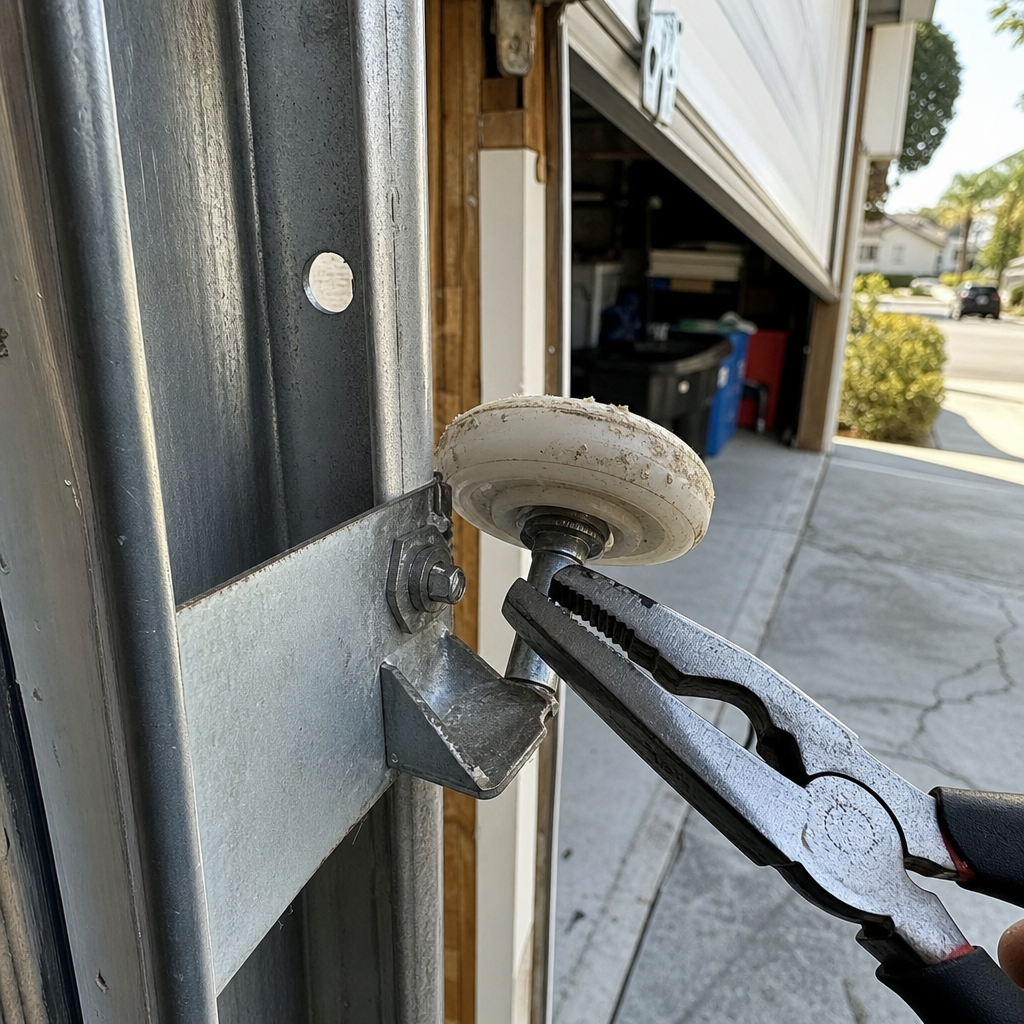
- Rollers. Nylon rollers with sealed bearings need no lubrication — but steel rollers need lithium grease on the bearing collar, not the roller stem. Check which you have before reaching for the can.
- Tracks. Do not lubricate the inside of the tracks. The rollers need friction against track walls to maintain alignment. Instead, wipe tracks clean with a dry cloth. The only thing going on tracks is occasional silicone spray on the track itself to reduce roller noise — applied sparingly.
- Top of the rail / drive screw or chain. For chain-drive openers (common in Craftsman and older Chamberlain units), apply a thin coat of white lithium grease to the chain with a rag — not a spray. For screw-drive openers (some older LiftMaster models), apply lubricant to the threaded rod per the manufacturer’s guide. Belt-drive openers, which run silently on most newer Genie and LiftMaster units, typically need no rail lubrication.
How to Test Auto-Reverse Sensitivity
California’s Title 24 residential code requires automatic garage door openers installed after 1993 to include auto-reverse functionality. Despite that, the auto-reverse test is the safety check we find most homeowners have never performed — not once — even on doors that have been in the home for a decade.
There are two separate systems to test, and both matter.
Test 1: Mechanical Auto-Reverse (Contact Reversal)
- Place a 2×4 flat on the ground in the center of the door’s path, wide face down.
- Close the door using the wall button or remote.
- When the door contacts the 2×4, it must reverse immediately and return to the open position.
- If it hesitates, presses down on the board, or continues closing, the close-force setting on your opener needs adjustment. On most LiftMaster, Chamberlain, and Genie units, there are two adjustment screws on the back or side of the motor housing labeled “UP Force” and “DOWN Force.”
- Adjust the DOWN Force screw in small increments (a quarter turn), retest until the door reverses cleanly.
Test 2: Photoelectric Safety Sensors (Non-Contact Reversal)
- With the door open, wave a broom handle through the sensor beam (the two small units mounted 4–6 inches off the floor on each side of the door frame) while pressing the close button.
- The door should immediately stop and reverse — or not begin moving at all.
- If the door continues moving, check that both sensor units are aligned (the sending unit has a steady amber light; the receiving unit should show a steady green light on most LiftMaster and Chamberlain systems). Misalignment is the most common failure we see after a Santa Ana wind event vibrates the mounting brackets loose.
- Clean the sensor lenses with a dry cloth — dust accumulation is common in LA’s dry months and can cause false readings.
If either test fails after adjustment, stop using the opener in the close direction and call for service. This is not a DIY repair.
Visual Inspection Guide for Stucco and Wood-Frame Homes
Los Angeles has a high concentration of stucco-clad homes built between the 1940s and 1980s, along with wood-frame craftsman and bungalow styles concentrated in neighborhoods like West Hollywood, Silverlake, Echo Park, and Los Feliz. Both construction types create specific garage door inspection concerns that don’t appear in standard guides.
Stucco Homes
- Check the door header framing. Stucco exteriors can conceal water infiltration from above the garage door opening. Look for staining, soft spots, or paint bubbling on the interior face of the header — this indicates moisture that will eventually compromise the top-section mounting hardware.
- Inspect the door jamb weather seal mounting. Stucco surfaces don’t hold staples or tack nails the way wood does. On older homes, the side seal often separates from the jamb surface over time. A separated side seal in the marine layer zone means moisture gets into the top section of a steel door and accelerates rust from the inside.
- Look at the mounting lag points for the horizontal track brackets. Stucco-covered framing sometimes has wood rot behind it. If a lag screw that holds the track turns freely without resistance, the framing behind it needs evaluation.
Wood-Frame Doors
- Inspect all panel joints for separation or soft spots. Southern California’s dry-heat summers cause wood doors to shrink and gap; the marine layer season then pushes moisture into those gaps. The cycle accelerates delamination in flush-panel wood doors.
- Check the bottom section along the floor line. Radiant heat from sun-exposed concrete driveways bakes the bottom panel from below. We regularly see bottom-section cracking on Amarr and Wayne Dalton wood composite doors in Valley neighborhoods where driveways face south or west.
- Paint and sealant condition. Bare or cracking paint on a wood door in Los Angeles isn’t just cosmetic — it exposes the substrate to UV damage that no amount of maintenance can reverse once it starts. Repaint or reseal at the first sign of checking.
When a Maintenance Task Becomes a Repair — and a Liability
Most of the tasks in this guide are genuine homeowner-level work: wiping tracks, lubricating hinges, testing sensors, checking weather seals. But several common garage door conditions look like maintenance items and are actually repair tasks that carry real injury risk — and in some cases, California liability exposure — if handled incorrectly.
Stop and Call a Professional If You See Any of These
- A broken or partially unwound torsion spring. Torsion springs on a standard two-car door store between 100 and 200 foot-pounds of torque when wound. Incorrect handling can cause severe injury. This is not a negotiable DIY task under any circumstances.
- A frayed or kinked cable. Lift cables and safety cables are under high tension even when the door is at rest. A frayed cable is not a “watch and wait” situation — it’s a spring-loaded failure waiting to happen.
- A bent or cracked bottom bracket. The bottom bracket is the junction point between the cable, the door panel, and the track system. In Los Angeles homes where doors have shifted on their foundation over decades, we see cracked bottom brackets fairly often. Replacing one requires releasing cable tension — a task that involves the same spring-tension risks.
- Any opener behavior after a sensor adjustment that still doesn’t pass the auto-reverse test. Once you’ve made two adjustments and the door still doesn’t reverse correctly, the issue is likely in the logic board or motor, not the adjustment screws. Further tinkering risks masking a safety failure.
- Misaligned or bent track sections. Pulling a bent track section back into alignment without understanding the spring tension currently loaded against it is how homeowners end up in the emergency room. If a roller has jumped the track or a vertical track is visibly bowed, that’s a service call.
California’s consumer protection framework under CSLB guidelines means that homeowners who attempt structural repairs to a garage door assembly and cause subsequent injury — to themselves or a guest — can face complications with their homeowner’s insurance claim. The maintenance tasks in this guide are explicitly designed to stay on the safe side of that line.
Common Mistakes to Avoid
- Using WD-40 as a lubricant. WD-40 is a water displacer, not a lasting lubricant. In Los Angeles summer heat, it evaporates off spring coils in under 90 days and leaves a gummy residue that attracts the fine particulate matter common in Valley air. Use white lithium grease instead.
- Lubricating the inside face of the tracks. This is the single most common “helpful” thing homeowners do that actually causes problems. Lubricated tracks reduce the roller-to-track friction that keeps your door aligned. The result is a door that wanders left or right and eventually derails a roller.
- Ignoring sensor light indicators. The amber and green lights on your photoelectric sensors are real-time diagnostics. A blinking or off light means misalignment or obstruction. In West Hollywood and neighboring areas where carport retrofits are common, sensors get bumped more often than in purpose-built garages. Check them monthly.
- Performing a balance test with a broken spring. If one torsion spring is broken and you disconnect the opener to test balance manually, the door will fall rapidly and cannot be caught safely. Before performing the manual balance test, visually confirm both springs are intact and continuous — no gaps in the coil.
- Skipping the weather seal replacement because “it’s not raining.” Los Angeles homeowners underestimate weather seal function because it rarely rains here. But a degraded bottom seal lets marine layer moisture, rodents, and the fine ash that accompanies fire season directly into the garage. A new bottom seal costs under $40 in materials.
- Applying touch-up paint to a wood door without addressing the underlying moisture. Painting over a soft or spongy section of a wood garage door panel traps moisture and accelerates rot. If the wood compresses when you press it, the panel needs replacement, not paint.
- Setting a reminder for “annual” maintenance and calling it done. In Los Angeles, a single annual service cycle doesn’t account for the marine layer season, the Santa Ana window, and the summer heat spike — three distinct stressor periods that each warrant a quick check. Quarterly eyes-on inspection is the right cadence here.
When to Call a Professional
Call a professional immediately if your door won’t open or close fully, if you hear a loud pop or bang from the spring area, if a cable has visibly snapped or is hanging loose, or if the door is leaning to one side when in motion. These are not “wait and see” situations — a door under partial spring tension is heavier than it looks and can drop without warning.
Schedule a professional inspection (rather than an emergency call) if your door is more than seven years old and has never had a professional tune-up, if you’ve noticed the opener straining or taking longer to complete a cycle than it used to, or if any of the visual checks in this guide turned up something you weren’t sure how to interpret.
Guardian Garage Door West Hollywood offers free estimates across Los Angeles — Christopher Moore personally handles diagnostic calls, so you get a straight answer from the technician who will do the work. Call (424) 321-7522 to schedule.
Frequently Asked Questions
How often should I lubricate my garage door in Los Angeles?
Lubricate your garage door twice a year at minimum — once in March before marine layer season, and once in August if you used a petroleum-based product earlier in the year (which you shouldn’t, but if you did, the heat will have already degraded it). Homes in coastal zones like Santa Monica, Mar Vista, or West Hollywood benefit from a third light lubrication in October to protect springs through the damp marine layer window. Use white lithium grease or silicone spray — never WD-40. Call (424) 321-7522 if you’d like us to handle the full lubrication service during a tune-up visit.
What does a garage door tune-up cost in Los Angeles?
A professional garage door tune-up in Los Angeles typically runs between $85 and $150, depending on door size, the number of springs, and whether any parts need replacing during the service. A single-car door with a straightforward opener system lands at the lower end; a two-car door with dual torsion springs, nylon roller replacement, and a full safety-sensor calibration sits closer to the top of that range. Guardian Garage Door provides free estimates — call (424) 321-7522 for an exact quote before committing to anything.
Can I replace a garage door spring myself in Los Angeles?
No — and this applies everywhere, not just Los Angeles. Torsion springs store extreme mechanical energy when wound, and incorrect installation causes serious injuries every year. California’s CSLB licensing framework treats spring replacement as repair work that should be performed by a licensed contractor. Beyond the injury risk, an incorrectly wound spring can void your opener’s warranty and cause premature cable wear. If your spring is broken or you suspect it’s losing tension, call a specialist — this is not a hardware-store fix.
How do I know if my garage door is properly balanced?
Disconnect your opener by pulling the red emergency release cord, then manually lift the door to approximately waist height and let go. A properly balanced door holds its position with no more than a few inches of drift in either direction. If the door drops quickly toward the floor, one or both springs are under-tensioned. If it flies upward toward the ceiling, the springs are over-tensioned. Either condition puts extra strain on your opener motor and signals that a spring adjustment is needed. Garage Door Repair in West Hollywood and across the greater Los Angeles area is one of our most common service calls — imbalance is more widespread than most homeowners realize.
How do Santa Ana winds affect my garage door?
Santa Ana wind events — which typically hit Los Angeles between October and March, with the strongest episodes in November and January — drive fine particulate matter into track channels, hinge pivot points, and sensor lenses. In the San Fernando Valley and foothill communities, we see roller wear and track contamination spike in the weeks following a significant Santa Ana. After any major wind event, wipe down your tracks with a dry cloth and check that your sensor lenses are clean and your sensor brackets haven’t been vibrated loose.
My LiftMaster opener is working but the door seems slow — what’s causing it?
A slow-moving garage door on an otherwise functional LiftMaster or Chamberlain opener almost always points to one of three things: dry or contaminated rollers creating friction the motor has to fight, a spring that’s losing tension and forcing the opener to carry more of the door’s weight than it should, or travel-limit settings that have drifted due to heat expansion in summer months. Start by lubricating the rollers and hinges. If speed doesn’t improve within a few cycles, have the spring tension and opener force settings evaluated professionally. Pushing a motor past its rated load shortens its lifespan significantly. For opener-specific issues, our Garage Door Opener in West Hollywood service covers diagnostics and repairs across all major brands.
The Bottom Line
A garage door in Los Angeles faces stressors that no generic checklist accounts for — marine layer moisture from May through July, Santa Ana wind contamination from October through March, and summer heat spikes that destroy the wrong lubricants within weeks. A 30-minute quarterly routine, calibrated to these actual conditions, prevents the majority of breakdowns we’re called out to fix. Use white lithium grease, test your auto-reverse twice a year, inspect your springs and cables visually every 90 days, and know the line between maintenance and repair. The homes and doors we see last the longest aren’t the ones with the newest hardware — they’re the ones with an owner who paid attention. If something in this guide turned up a concern, Garage Door Installation in West Hollywood and repair services are available across Los Angeles — call (424) 321-7522 for a free estimate.
Written by Christopher Moore, Owner & Lead Technician at Guardian Garage Door West Hollywood, serving Los Angeles since 2015. Over 1,200 five-star customers and 11 years of focused garage door specialization back every recommendation in this guide.