
Last updated June 28, 2026
Garage Door Permits, Codes & Inspections in CA: What You Need to Know
Most homeowners replacing a garage door assume the process works like swapping an appliance — out with the old, in with the new, done. In Los Angeles County, that assumption can cost you thousands. A straightforward door replacement that requires zero paperwork in Phoenix triggers a permit requirement, a seismic compliance review, and a mandatory inspection in many California jurisdictions. Some contractors know this and don’t tell you, because permits slow down the sale and complicate the bid. This guide gives you the jurisdiction-specific facts you need before any work starts — what triggers a permit, what the inspector actually checks, and what happens if you skip the process.
Quick Answer
In California, garage door projects that involve structural changes, new openers hardwired to your electrical system, or any work in a seismic design category require a building permit in most Los Angeles County jurisdictions. A like-for-like door panel swap on an existing frame typically does not require a permit, but a full door-and-frame replacement almost always does. Getting this wrong can void your homeowner’s insurance coverage for related claims and create a title disclosure problem when you sell.
Table of Contents
- Which Garage Door Projects Require a Permit in California?
- LA County vs. City of Los Angeles vs. West Hollywood: The Differences Matter
- California’s Seismic Code and What It Means for Your Garage Door
- How Unpermitted Work Affects Your Homeowner’s Insurance
- How to Retroactively Permit Existing Unpermitted Work
- What an LA Building Inspector Actually Checks
- Common Mistakes to Avoid
- When to Call a Professional
- Frequently Asked Questions
- The Bottom Line
Which Garage Door Projects Require a Permit in California?
California’s permit requirement for garage doors flows from Title 24 of the California Code of Regulations and is administered locally by individual building departments. The threshold is not whether the door is “new” — it’s whether the work affects structure, safety systems, or seismic resistance.
Projects that typically require a permit in California:
- Full replacement of a garage door and its surrounding framing or header
- Widening or narrowing an existing garage door opening
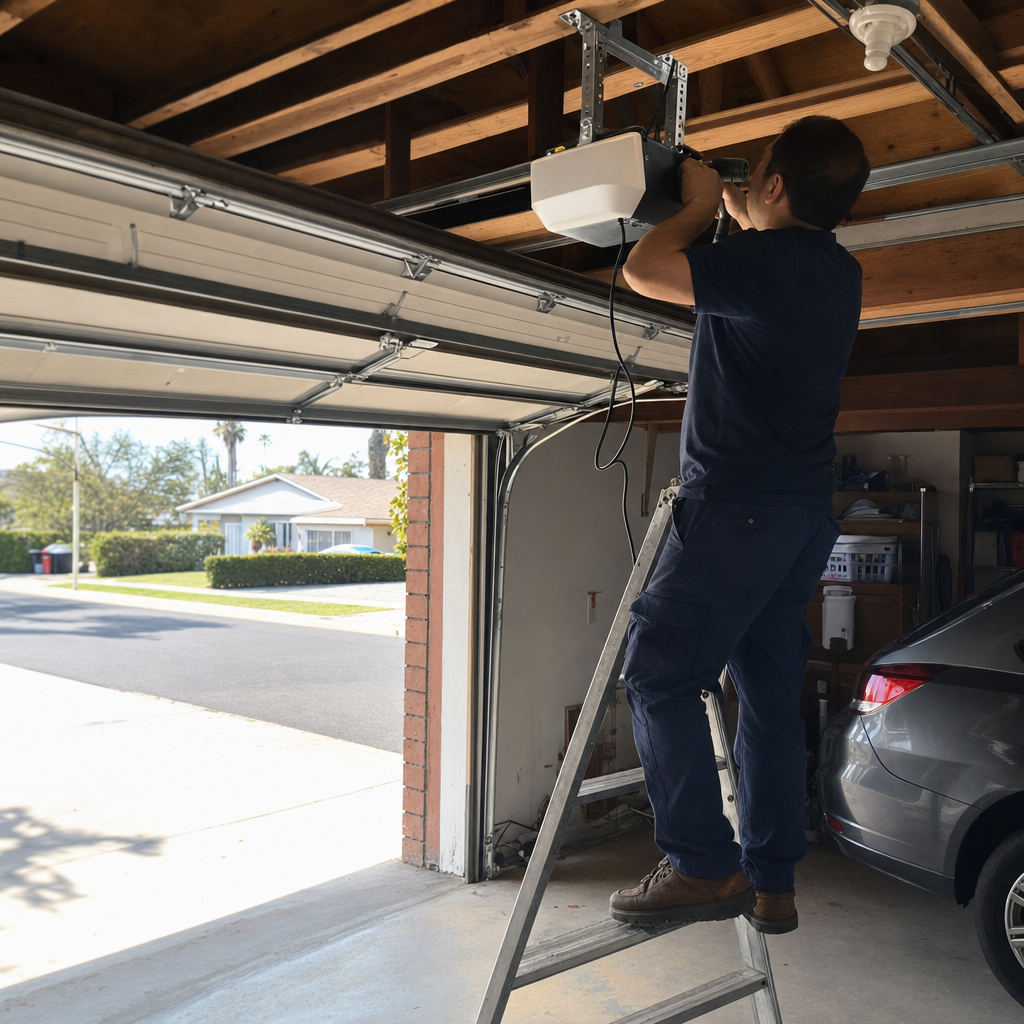
- Installing a new garage door opener with hardwired electrical connections (requires an electrical permit in addition to the building permit in most jurisdictions)
- Adding or modifying an automatic reverse safety system as part of new construction
- Any work in a designated seismic design category that alters the shear wall panel adjacent to the garage opening
- Converting a garage space into living area — which affects the door’s role in the building envelope
Projects that typically do not require a permit:
- Replacing a broken spring, cable, or roller on an existing door
- Swapping out a garage door panel for a matching replacement panel on the same frame
- Replacing a plug-in garage door opener with a new plug-in unit of the same voltage
- Lubricating, adjusting, or realigning an existing door system
In our 11 years working specifically on garage doors in the Los Angeles area, the single most common permit error we see is a contractor replacing an entire door and frame and calling it a “panel swap” to avoid triggering the permit process. It’s not a technicality — it’s a misrepresentation that puts the homeowner at risk.
LA County vs. City of Los Angeles vs. West Hollywood: The Differences Matter
This is the section most guides skip entirely, and it’s where homeowners get into real trouble. California sets the baseline through Title 24 and the California Building Code (CBC), but every local jurisdiction is allowed to adopt amendments — and Los Angeles County, the City of Los Angeles, and the City of West Hollywood have all done exactly that.
Los Angeles County (Unincorporated Areas)
Unincorporated LA County — areas like Hacienda Heights, Altadena, and East Los Angeles — falls under the Los Angeles County Department of Regional Planning and the LA County Building and Safety division. The county follows the CBC with local amendments and generally requires a permit for any full garage door replacement that alters the opening dimensions or involves new framing. Permit fees in unincorporated LA County typically run $150–$350 for a standard residential garage door project, depending on valuation.
City of Los Angeles
The City of Los Angeles — which includes neighborhoods like Silver Lake, Koreatown, Brentwood, and Van Nuys — is regulated by the Los Angeles Department of Building and Safety (LADBS). The City of LA has historically had stricter seismic documentation requirements than the county baseline, particularly for homes in Seismic Design Category D, which covers most of the city. LADBS also requires that any hardwired opener installation pull a separate electrical permit, and inspectors in Los Angeles have been known to flag unpermitted garage work discovered during unrelated inspections. Permit fees through LADBS for a full door replacement with framing work typically range from $200–$450.
City of West Hollywood
West Hollywood operates its own building department and has adopted additional requirements around historic preservation and design review for properties in certain overlay districts. A door replacement that’s straightforward in the San Fernando Valley may require a design review sign-off in West Hollywood before a building permit is even issued. Homeowners in West Hollywood replacing doors on older Spanish Colonial or mid-century properties should confirm with the city’s Community Development Department before any work begins. Permit timelines in West Hollywood can run longer than the county baseline — budget two to four weeks for permit approval on non-emergency projects.
California’s Seismic Code and What It Means for Your Garage Door
California Building Code Section 1613 governs seismic design requirements, and its implications for garage doors are poorly understood by both homeowners and, frankly, some contractors. The short version: the wall panels on either side of a garage door opening are load-bearing shear wall segments. When you replace a door, change an opening width, or modify the framing, you are potentially altering the structural system that holds your house together during an earthquake.
What seismic-compliant garage door installation looks like in the field:
- Pier and holddown verification: The anchor bolts and holddown hardware connecting the shear wall segments to the foundation must be intact and meet current code specifications. In homes built before 1980 in Los Angeles, these are often absent or undersized.
- Header sizing: The header beam spanning the garage opening must be correctly sized for the span. Undersized headers are a common finding in older homes in areas like Eagle Rock, Glassell Park, and the eastern San Gabriel Valley foothills.
- Panel-to-panel connection: The door’s horizontal tracks must be properly anchored to framing members, not just to drywall or plywood sheathing.
- Seismic documentation: For projects in Seismic Design Category D (which covers virtually all of Los Angeles), the contractor must either use a pre-engineered door system with tested seismic ratings or provide an engineer’s letter confirming the installation meets CBC 1613 requirements.
Brands like Clopay, Amarr, and Wayne Dalton publish seismic performance data for their door systems. When we install these doors in Los Angeles, we pull that documentation and confirm it aligns with the site’s seismic design category — because if there’s ever a claim or a sale, that paper trail matters.
How Unpermitted Work Affects Your Homeowner’s Insurance
This is the consequence that gets the least attention and does the most damage. California homeowner’s insurance policies contain a standard exclusion for losses “arising from or contributed to by work performed without required permits.” This language is broad enough that an insurer can use unpermitted garage door work to deny or reduce a claim that seems unrelated — for example, a water intrusion claim if the unpermitted door frame was not properly flashed, or a structural claim after seismic activity if the shear wall configuration was altered without inspection.
Here’s how that plays out practically in Los Angeles:
- An adjuster arrives to assess earthquake damage. They pull the property’s permit history through the LADBS or LA County records portal — this is a standard step in California claims processing.
- They find that the garage door was replaced three years ago with no permit on record.
- If the door opening is in a shear wall, the insurer may argue the unpermitted work altered the seismic resistance of the structure, contributing to the loss.
- The claim is partially or fully denied under the “illegal construction” exclusion.
We’ve heard this scenario described by homeowners we’ve spoken with in neighborhoods from Silver Lake to Culver City — and it’s always a shock, because the door looked fine before the earthquake. The permit wasn’t about the door looking right. It was about the work being documented and inspected.
How to Retroactively Permit Existing Unpermitted Work
If you’re selling a home in Los Angeles and you discover unpermitted garage door work during the title or escrow process, you have options — but time matters. California requires sellers to disclose known unpermitted work, and buyers’ lenders will often require the work to be legalized before funding. Here’s the actual process:
- Pull the property’s permit history. In the City of Los Angeles, this is available through the LADBS public portal. For unincorporated areas, use the LA County permit records system. Confirm exactly what was permitted and when.
- Contact the local building department. Explain that you have existing unpermitted work and want to bring it into compliance. Most jurisdictions in Los Angeles have a process for this — sometimes called a “permit to legalize” — and staff are accustomed to handling it during property sales.
- Schedule a pre-inspection or plan check. An inspector will assess whether the existing installation meets current code. If it does, they’ll issue an approval. If it doesn’t, you’ll need corrective work before approval is granted.
- Complete corrective work if required. This might mean adding holddown hardware, resizing a header, or verifying the opener’s safety sensor alignment. Budget $300–$1,200 for minor corrective work in the Los Angeles area, depending on the scope.
- Pay the retroactive permit fee plus any applicable penalty. Jurisdictions in LA County typically charge a penalty multiplier — often 1.5x to 3x the standard permit fee — for retroactive permits. For a standard door replacement, expect $300–$900 total for the retroactive permit.
- Pass the final inspection. Once the inspector signs off, the work is on record and the disclosure issue is resolved.
Timeline: In our experience dealing with these situations in the Los Angeles market, a straightforward retroactive permit takes three to eight weeks from first contact with the building department to final inspection sign-off. During a hot escrow, that timeline can create real pressure — start early.
What an LA Building Inspector Actually Checks
When a building inspector arrives for a garage door final inspection in Los Angeles, they are not casually glancing at the door. They are working through a specific set of code compliance points. Knowing what’s on that checklist helps you confirm your contractor actually did the job right before the inspector arrives — and before you write the final check.
Standard final inspection points for a garage door installation in Los Angeles:
- Auto-reverse compliance: The door must reverse within two seconds of contact with a 1.5-inch object placed on the floor. This requirement comes from UL 325, the national standard for residential garage door operators — openers from LiftMaster, Chamberlain, Genie, Craftsman, and Raynor all include this system, but it must be calibrated correctly.
- Photoelectric sensor placement and alignment: Sensors must be mounted no more than six inches above the floor, properly aligned, and confirmed functional.
- Manual disconnect: The red emergency release cord must be present and functional.
- Header clearance: Sufficient clearance above the door for the track and opener mounting hardware, per the manufacturer’s installation specs.
- Framing and structural connections: The inspector will visually confirm that the door frame is properly connected to the surrounding framing and that the track hardware is anchored to structural members.
- Electrical work (if applicable): If a hardwired opener was installed, the inspector will confirm the circuit is properly protected, the outlet or conduit is correctly installed, and the work matches the electrical permit.
- Seismic documentation review: In Seismic Design Category D projects, the inspector may ask to see the manufacturer’s seismic data or engineer’s letter confirming compliance with CBC Section 1613.
One thing we consistently tell homeowners in Los Angeles: ask your contractor to walk you through each of these points before the inspector arrives. A contractor who can’t or won’t do that is a contractor who hasn’t done the job to code.
Common Mistakes to Avoid
- Assuming “no permit needed” without checking your specific jurisdiction. Rules differ between LA County unincorporated areas, the City of Los Angeles, and cities like West Hollywood or Beverly Hills. What your neighbor did on their house in Alhambra may not apply to your house in Los Feliz.
- Hiring a contractor who volunteers to “skip the permit to save you money.” This shifts all liability to you as the homeowner. The money saved on a permit fee is trivial compared to the insurance exposure and title risk you’re absorbing.
- Confusing a panel replacement with a full door replacement. If the frame, header, or opening dimensions change at all, it’s a full replacement in the eyes of the building department — and a permit is required regardless of what the contractor calls it.
- Installing a hardwired opener without pulling an electrical permit. Los Angeles building inspectors have flagged unpermitted electrical work on garage door openers during unrelated inspections, triggering stop-work orders on active projects. Don’t let one overlooked permit snowball.
- Ignoring shear wall implications in pre-1980 homes. Many homes in the Los Feliz, Highland Park, and Boyle Heights areas were built before modern seismic codes. A full door replacement in these homes almost always requires a structural review — assuming otherwise is how people end up with non-compliant installations they discover at escrow.
- Failing to document the permit closure before the contractor leaves. A permit is only fully closed when the final inspection is signed off. Some contractors pull the permit, do the work, and never schedule the inspection — leaving you with an open permit on the property record that can complicate a future sale.
- Not disclosing known unpermitted work when selling. California Civil Code requires sellers to disclose known material defects, and unpermitted work qualifies. Non-disclosure can expose you to post-sale litigation even after escrow closes.
When to Call a Professional
Call a professional before any work starts if your project involves a full door replacement, any change to the opening dimensions, or a hardwired opener installation — these all trigger permit requirements in most Los Angeles jurisdictions and involve structural and electrical work that goes beyond a straightforward swap.
Call a professional immediately if you’re in escrow and have discovered unpermitted garage door work. The retroactive permit process has a real timeline and needs to start the day you learn about the problem, not a week later.
Call a professional for any door that won’t move, won’t stay closed, or has a broken spring — these are security and safety issues, not just inconveniences. A door stuck open overnight in a Los Angeles neighborhood is an invitation for a very different kind of problem.
Guardian Garage Door West Hollywood offers free estimates across Los Angeles — Christopher Moore, our owner and lead technician, handles the work directly so there’s no crew of strangers showing up on your property. Call (424) 321-7522 to schedule.
Frequently Asked Questions
Do I need a permit to replace a garage door in Los Angeles?
In most cases, yes — if you’re doing a full door and frame replacement in Los Angeles. A like-for-like panel swap on an existing, undamaged frame generally does not require a permit, but any work that modifies the opening dimensions, replaces the header, or involves new hardwired electrical for an opener triggers a permit requirement under the LA Department of Building and Safety guidelines. When in doubt, call LADBS at their permit counter before the work starts, not after. For a fast, honest assessment of your project’s permit requirements, call Guardian Garage Door at (424) 321-7522 — estimates are free.
What is California’s seismic code requirement for garage doors?
California Building Code Section 1613 requires that structural elements in Seismic Design Category D — which covers virtually all of Los Angeles — be designed and installed to withstand seismic forces. For garage doors, this means the header, framing, shear wall panels adjacent to the opening, and foundation connections must all meet current code specs. In practice, compliant installation uses pre-engineered door systems with published seismic ratings (Clopay, Amarr, and Wayne Dalton all publish this data) and proper anchor hardware. An inspector will ask for documentation confirming compliance on larger projects.
Will unpermitted garage door work void my homeowner’s insurance?
It can — and in Los Angeles, it does happen. California homeowner’s insurance policies typically exclude losses “arising from or contributed to by work performed without required permits.” If an adjuster pulls your permit history (a standard step in California claims processing) and finds unpermitted structural work connected to the loss, the claim can be partially or fully denied. This is most relevant after seismic events, water intrusion through improperly flashed framing, or any structural failure tied to the garage area.
How much does a retroactive garage door permit cost in Los Angeles?
Expect to pay $300–$900 total for a retroactive permit in Los Angeles County jurisdictions, including the penalty multiplier (typically 1.5x to 3x the standard fee) that most LA-area building departments charge for after-the-fact permitting. If corrective work is required to bring the installation up to current code, add $300–$1,200 depending on scope. The timeline from first contact with the building department to final inspection sign-off typically runs three to eight weeks in the Los Angeles market.
Is West Hollywood’s permit process different from the City of Los Angeles?
Yes, meaningfully so. West Hollywood operates its own building department and has adopted design review requirements for properties in certain overlay districts — particularly homes with historic or architectural significance. A door replacement that clears permitting in two weeks in the Valley may require a design review sign-off in West Hollywood that adds several weeks to the timeline. Always confirm with West Hollywood’s Community Development Department before starting any exterior work, including garage doors. Our Garage Door Installation in West Hollywood page covers what this process looks like in practice.
Can I install a garage door opener without a permit in California?
A plug-in opener replacing an existing plug-in unit of the same voltage generally does not require a permit. A hardwired opener installation almost always requires both a building permit and a separate electrical permit in Los Angeles jurisdictions. The electrical permit requirement catches many homeowners off guard, and inspectors in Los Angeles actively flag unpermitted hardwired opener work. If your contractor quotes you a hardwired opener installation and doesn’t mention permits, ask the question directly. For a code-compliant LiftMaster, Chamberlain, or Genie opener installation in the Los Angeles area, call (424) 321-7522.
The Bottom Line
California’s garage door permit requirements are not bureaucratic red tape — they’re the mechanism that ensures your door’s installation is structurally sound, seismically compliant, and on record when your insurance company or a future buyer needs to verify it. In Los Angeles specifically, the combination of Seismic Design Category D requirements, LADBS enforcement, and jurisdiction-specific rules in cities like West Hollywood makes this a more nuanced process than homeowners expect. Know what triggers a permit, confirm your contractor pulls one, verify the final inspection is closed, and keep the paperwork. Those four steps protect your home, your coverage, and your ability to sell without surprises. If you have questions about a specific project, our team is a phone call away.
For anything related to Garage Door Repair in West Hollywood or a new installation anywhere in the Los Angeles area, Guardian Garage Door West Hollywood is ready to walk you through the process start to finish — permits included. Explore the full range of services on the Guardian Garage Door West Hollywood home page, or call Christopher directly at (424) 321-7522 for a free estimate with no pressure and no surprises.
For opener-specific questions, our Garage Door Opener in West Hollywood page covers installation, permit requirements, and brand options in detail.
Written by Christopher Moore, Owner & Lead Technician at Guardian Garage Door West Hollywood, serving Los Angeles since 2015.